|
| KOKKOS_FUNCTION sil::exterior::Form< std::array< double, 3 > > | field (sil::exterior::Form< std::array< double, 3 > > const &induction, double reluctivity) const |
| |
| template<class Law , class Element > |
| KOKKOS_FUNCTION sil::exterior::Form< std::array< double, 3 > > | constitutive_field (Law const &law, typename Law::State const &state, Element const &element) const |
| |
| template<class Metric , class Element > |
| KOKKOS_FUNCTION | MagneticFormResponse (Metric const &metric, Element const &element) |
| |
| template<class Equations , class Element > |
| KOKKOS_FUNCTION sil::exterior::Form< std::array< double, 3 > > | field (Equations const &equations, typename Equations::State const &state, Element const &element) const |
| |
| template<class Equations , class Element > |
| KOKKOS_FUNCTION std::array< double, 9 > | jacobian (Equations const &equations, typename Equations::State const &state, Element const &element) const |
| |
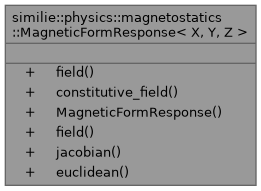
template<class X, class Y, class Z>
class similie::physics::magnetostatics::MagneticFormResponse< X, Y, Z >
Isotropic magnetic response H = nu(|B|_g) star_g B in three dimensions.
- Important
- This operator and documentation is fully AI-generated. B contains differential 2-form coefficients (B_yz, B_zx, B_xy), and the output contains 1-form coefficients (H_x, H_y, H_z). No cochain measures enter this operator. The metric and orientation belong to the continuous Hodge star; callers separately reconstruct and reduce their cochains.
The supplied equations describe the material energy in an orthonormal frame. Evaluating them along (|B|_g,0,0) provides the radial material law. The metric is Riemannian and the coordinate orientation is positive. This applies to isotropic materials only. The tangent differentiates the same metric norm and Hodge map as the field, including off-diagonal terms.
Definition at line 30 of file magnetic_form_response.hpp.

 1.12.0