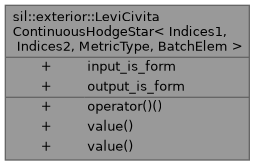
Continuous Hodge star for an identity metric and the positive coordinate orientation.
More...
|
| template<FormType HodgeTensorType, FormType FormTensorType> |
| static KOKKOS_FUNCTION void | operator() (HodgeTensorType const &hodge_tensor, FormTensorType const &form_tensor, MetricType const &, BatchElem) |
| |
| static KOKKOS_FUNCTION detail::LocalOperatorStencil< tensor::lower_t< reduction_index_t< Indices1 > >, reduction_index_t< Indices2 > > | value (MetricType const &metric, BatchElem element) |
| |
| template<class NaturalElement > |
| static KOKKOS_FUNCTION double | value (MetricType const &, BatchElem, NaturalElement natural) |
| |
template<misc::Specialization< ddc::TypeSeq > Indices1, misc::Specialization< ddc::TypeSeq > Indices2, class MetricType, class BatchElem>
class sil::exterior::LeviCivitaContinuousHodgeStar< Indices1, Indices2, MetricType, BatchElem >
Continuous Hodge star for an identity metric and the positive coordinate orientation.
- Important
- This operator and documentation is fully AI-generated. The Levi-Civita tensor has no stored coefficients. Contracting its source indices with a k-form and dividing by k! gives the complementary (n-k)-form. The factorial accounts for the permutations of the antisymmetric input in the full natural-index contraction performed by tensor_prod.
Definition at line 24 of file levi_civita_continuous_hodge_star.hpp.

 1.12.0